

The Best Internal Temperature for Steak: Rare to Well Done Explained
Learn the best steak internal temperatures for every doneness level from blue rare to well done. This guide explains steak temps, doneness levels, and temp accuracy so you can cook steak perfectly every time.
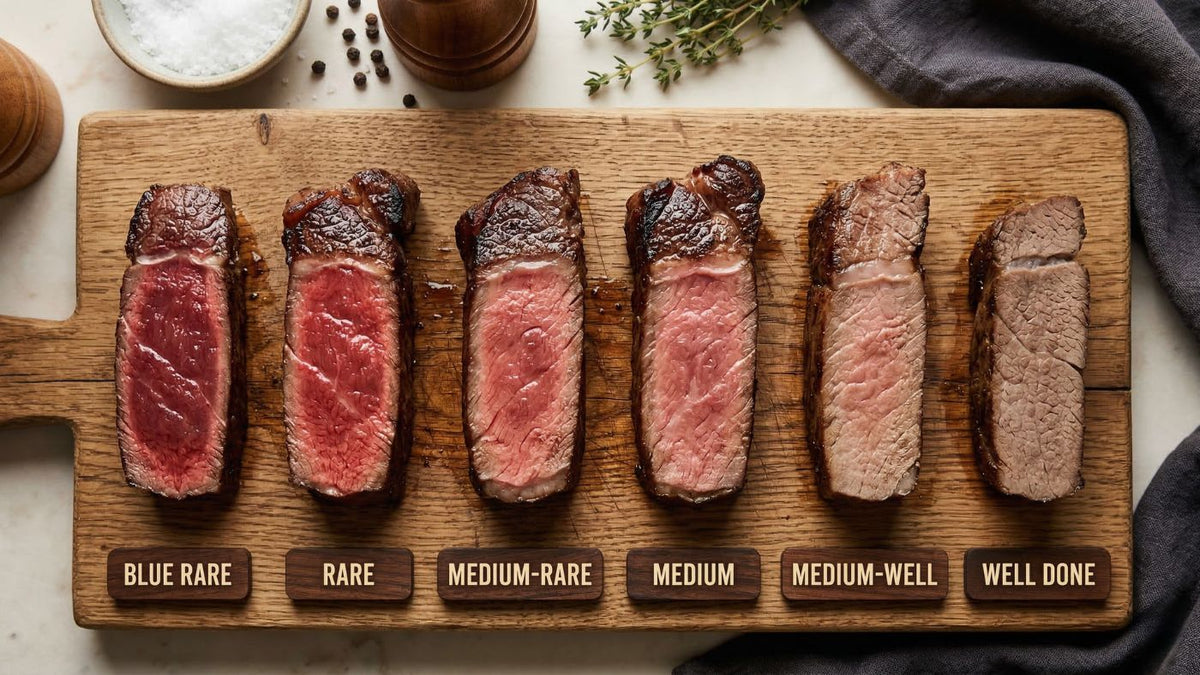
The short answer
Steak doneness comes down to internal temperature: rare 120 to 125°F (49 to 52°C), medium rare 130 to 135°F (54 to 57°C), medium 140 to 145°F (60 to 63°C), medium well 150 to 155°F (66 to 68°C) and well done 160°F (71°C) and up. Take the steak off the heat about 5°F (3°C) before your target and rest it 5 to 10 minutes: carryover lands it on the number. The USDA's minimum for whole cuts of beef is 145°F (63°C) with a 3 minute rest.
Cooking steak properly comes down to one thing: internal temperature. Steak temps determine the doneness level, texture, and juiciness of the final steak. If you want consistent results, the most reliable method is measuring internal temperature with a meat thermometer rather than relying on timing or visual guesses.
Different doneness levels correspond to specific temperature ranges. Once you understand these ranges and monitor temp accuracy while cooking, hitting your preferred doneness becomes straightforward. Wireless meat thermometers make this easier because you can track steak temps continuously without cutting into the meat.
Below is a clear guide to steak internal temperatures that define each doneness level.

Steak doneness is defined by internal temperature. As heat increases, muscle fibers tighten and push out moisture. This changes the texture, color, and juiciness of the meat.
Because steak cooks quickly near the end of cooking, temp accuracy matters. A difference of just a few degrees can move the steak from one doneness level to the next.
Steak Doneness and Internal Temperature Chart
|
Doneness Level |
Internal Temperature |
Chef Favorite |
USDA Safe |
|
Blue Rare |
110-115°F (43-46°C) |
No |
No |
|
Rare |
120-125°F (49-52°C) |
No |
No |
|
Medium Rare |
130-135°F (54-57°C) |
Yes |
No |
|
Medium |
140-145°F (60-63°C) |
Sometimes |
Yes |
|
Medium Well |
150-155°F (66-68°C) |
No |
Yes |
|
Well Done |
160°F+ (71°C+) |
No |
Yes |
Blue Rare
Internal temperature: 110°F to 115°F (43°C to 46°C)
Blue rare steak is lightly seared on the outside while the interior remains almost raw.
Key characteristics:
-
Very cool red center
-
Extremely soft texture
-
Minimal cooking of the interior
-
Thin seared crust
Blue rare is typically chosen for very tender cuts like filet mignon or ribeye. Because the temperature range is narrow, precise temperature measurement is essential.
Rare
Internal temperature: 120°F to 125°F (49°C to 52°C)
Rare steak has a cool red center and a soft, juicy texture.
Key characteristics:
-
Bright red interior
-
Warm outer layers with a cool center
-
Very tender texture
-
High moisture retention
Rare steak highlights the natural flavor of the beef and is best suited for high quality cuts.
Medium Rare
Internal temperature: 130°F to 135°F (54°C to 57°C)
Medium rare is widely considered the ideal doneness level for steak because it balances tenderness and flavor development.
Key characteristics:
-
Warm red center
-
Juicy interior
-
Slightly firmer texture than rare
-
Well developed seared crust
Most steakhouses aim for medium rare because it provides the best combination of tenderness, moisture, and flavor.
Medium

Internal temperature: 140°F to 145°F (60°C to 63°C).
Medium steak has a warm pink center and a firmer texture compared to medium rare.
Key characteristics:
-
Pink center
-
Moderate juiciness
-
Firmer texture
-
More pronounced cooked flavor
This doneness level is common for diners who prefer less visible red in their steak.
Medium Well
Internal temperature: 150°F to 155°F (66°C to 68°C)
Medium well steak has only a small amount of pink remaining in the center.
Key characteristics:
-
Slight pink center
-
Firm texture
-
Reduced moisture
-
Strong cooked flavor
At this stage, temperature control becomes important because a few additional degrees can easily push the steak into well done territory.
Well Done
Internal temperature: 160°F and above (71°C+).
Well done steak is fully cooked with no pink remaining.
Key characteristics:
-
Brown interior
-
Firm texture
-
Low moisture
-
Fully developed cooked flavor
Because moisture loss increases significantly at higher temperatures, careful monitoring helps prevent excessive dryness.
Why Temp Accuracy Matters

Steak cooks quickly during the final stage of cooking. Even a small change in temperature can shift the doneness level.
For example:
-
125°F is rare
-
135°F is medium rare
-
145°F is medium
Factors that influence how quickly a steak reaches these temperatures include:
-
Steak thickness
-
Starting meat temperature
-
Cooking surface heat
-
Fat content of the cut
-
Cooking method
Because these variables change from cook to cook, measuring internal temperature is the most reliable way to achieve consistent results.
Carryover Cooking
Steak continues cooking after it leaves the heat source due to retained heat inside the meat. This effect is known as carryover cooking.
Typical carryover increase: 3°F to 5°F
Examples:
-
Remove steak at 130°F if targeting 135°F medium rare
-
Remove steak at 140°F if targeting 145°F medium
Allowing the steak to rest for several minutes also helps redistribute juices, improving texture and flavor.
Wireless meat thermometers are especially useful during this stage because they allow you to continue monitoring steak temps without disturbing the meat.
Cooking Methods That Help Maintain Accurate Steak Temps
Different cooking methods can produce excellent steak, but temperature monitoring remains the most important factor.
Reverse Searing
Reverse searing is one of the most reliable methods for achieving precise doneness. Steps:
-
Slowly heat the steak in an oven or indirect grill.
-
Monitor internal temperature as it approaches your target.
-
Finish with a hot sear for crust.
Because the steak heats gradually, it is easier to hit exact steak temps.

Pan Searing
Pan searing is common for indoor cooking. Basic approach:
-
Heat a heavy skillet until hot.
-
Sear the steak to build crust.
-
Finish cooking while monitoring internal temperature.
Monitoring temperature prevents overshooting the target doneness.
Grilling
Grilling adds strong flavor but can create uneven heat zones. To maintain temp accuracy:
-
Use two-zone cooking on the grill
-
Cook indirectly first if the steak is thick
-
Finish with high heat to develop the crust
Wireless meat thermometers help track temperature while the grill lid remains closed.
Is medium-rare steak safe? Doneness vs. safety
Doneness and safety are two different questions, and steak is the one meat where they separate cleanly.
On a whole, intact steak, bacteria live on the surface, not inside the muscle. A proper sear takes that surface far past any temperature bacteria can survive, which is why steakhouses have served rare and medium-rare beef for a century. The USDA's recommended minimum for whole cuts of beef is 145°F (63°C) with a 3 minute rest, which lands at medium; cooking below that is a personal judgment millions of cooks make every day on intact, well-seared cuts.
Ground beef is the opposite case. Grinding mixes the surface through the middle, so the safe number applies to the center: 160°F, no exceptions. The same logic applies to mechanically tenderized (blade or needle tenderized) steaks, which should be cooked to 145°F because the surface has been pushed inside.
Steak temperature by cooking method
The finished internal temperature is the same no matter how you cook it. What changes by method is the cooker temperature and the path you take to the target.
| Method | Cooker temp | How to run it |
|---|---|---|
| Grill (hot and fast) | 450–550°F / 230–290°C | Sear over direct heat, then finish over indirect until you hit pull temp |
| Two-zone grill | 350–450°F / 175–230°C | The classic setup for 1-inch steaks; sear, flip, slide to the cool side |
| Cast iron pan sear | High heat, preheated | Sear both sides hard, baste, and pull about 5°F before your target |
| Reverse sear | 250°F / 121°C oven, then 500°F+ / 260°C+ sear | Low and slow to about 110°F (43°C) for medium-rare, then a short hard sear |
| Smoker | 225–250°F / 107–121°C | Best for tri-tip and thick cuts; smoke to just below pull temp, then sear |
| Sous vide | Water bath set at your final target | The bath holds the steak at target; sear fast at the end so you do not push past it |
The timing pattern for a standard 1-inch steak on a two-zone grill is the 3-3-3 rule for steak: 3 minutes per side over direct heat, then 3 minutes per side on indirect. For steaks over 1.5 inches, the reverse sear gives you a more even edge-to-edge finish. And if you are choosing what to cook in the first place, start with our guide to the 5 best cuts of steak.
Quick Tip: The thicker the steak, the less the clock can tell you. A 2-inch ribeye and a 1-inch sirloin can finish 10 minutes apart at the same grill temperature. The internal reading is the only number that holds across methods and thicknesses.
How long to cook steak (and why time is the wrong question)
Every "grill 4 minutes per side" chart is guessing on your behalf. Cook time depends on thickness, the starting temperature of the meat, how hot your grill actually runs, and even the wind on your patio. Two steaks from the same pack can finish minutes apart.
Use time to plan and temperature to decide. A 1-inch steak over direct high heat runs roughly 3 minutes per side plus a short indirect finish, which is exactly the pattern the 3-3-3 rule packages. But the moment the Stick reads your pull temp, the steak comes off, whatever the clock says. That is the whole trick: stop overcooking steaks by letting the number end the cook, not the timer.
Carryover cooking: pull it before it is done
A steak keeps cooking after it leaves the heat. The hot outer layers push heat toward the center while it rests, raising the internal temperature about 5°F on a typical steak.
That is why every row of the chart has a pull temp below the final temp. MeatStick recommends pulling your steak about 5°F below your target doneness and resting it 5 to 10 minutes: carryover lands it exactly on the number, and the rest lets the juices thicken and redistribute so they stay in the meat instead of on the cutting board.
Quick Tip: Pulling at 130°F and resting gets you a perfect 135°F medium-rare. Pulling at 135°F gets you medium. Five degrees is the entire difference, which is why guessing fails so often.
Where to measure for an accurate reading
A reading is only as good as its placement. The center of the thickest part of the steak is the coldest spot and the last to come up to temperature; that is the number that matters.
- Insert from the side, not the top, so the sensor sits in the middle of the meat rather than passing through it.
- Aim for the center of the thickest section of the cut.
- Avoid fat pockets, gristle, and bone. They heat differently than muscle and will skew the reading.
- On thin steaks, side insertion is the only way to get the sensor properly seated in the center.
Steak doneness myths
The poke test. Comparing the steak's firmness to the base of your thumb is a party trick, not a measurement. Firmness varies by cut, aging, thickness, and temperature of the raw meat. Chefs who make it look reliable cooked thousands of steaks to calibrate their hands; a thermometer calibrates for you.
Cutting in to check. The cut you make to peek is the cut the juices escape through, and the color you see mid-cook is not the color the rested steak will settle at. You pay for the answer with the juiciness you were trying to protect.
"The red juice is blood." It is not. The red liquid in a steak is myoglobin, a protein that carries oxygen in muscle, mixed with water. We break the whole thing down in the truth about the "blood" in meat.
Color tells you doneness. Interior color shifts with the cut, the animal's diet, and even lighting. The only doneness signal that works every time is the internal temperature.
Steak food safety
- The danger zone is 40°F to 140°F (4°C to 60°C). Do not leave raw or cooked beef in that range for more than 2 hours (1 hour above 90°F outside).
- Whole cuts: the USDA recommends a minimum of 145°F (63°C) plus a 3 minute rest.
- Ground beef: 160°F (71°C), always, including burgers, meatballs, and meatloaf.
- Thaw in the fridge, not on the counter; counter thawing parks the surface in the danger zone for hours.
- Leftovers: refrigerate within 2 hours, eat within 3 to 4 days, and reheat to 165°F (74°C).
Frequently Asked Questions
What temperature is a medium-rare steak? Medium-rare steak is 130 to 135°F (54 to 57°C): a warm red center and the most popular doneness. Pull it off the heat at 125 to 130°F and rest it 5 to 10 minutes; carryover heat finishes the job. The MeatStick doneness guide treats 130 to 135°F as the medium-rare window.
What temperature is steak done? It depends on the doneness you want: 125°F rare, 130 to 135°F medium-rare, 140 to 145°F medium, 150 to 155°F medium-well, and 160°F+ well-done. For food safety, the USDA recommends 145°F with a 3 minute rest for whole cuts of beef.
What temp should I pull steak off the grill? About 5°F below your target doneness. For a 135°F medium-rare finish, pull at 130°F; for a 145°F medium finish, pull at 140°F. Carryover cooking closes the gap while the steak rests.
Is medium-rare steak safe to eat? On a whole, intact, well-seared steak, bacteria live on the surface and the sear takes that surface far past survivable temperatures. The USDA's official recommendation is 145°F with a 3 minute rest; eating medium-rare below that is a personal choice millions of cooks make daily. Ground beef is different and always needs 160°F.
What temperature is a medium steak? Medium steak is 140 to 145°F (60 to 63°C), a warm pink center that is firmer than medium-rare but still juicy. Pull it around 135 to 140°F and let carryover finish it during the rest.
What temperature is well-done steak? Well-done steak is 160°F (71°C) or higher, with no pink remaining. Cook it gently after the sear; at this temperature most of the free moisture has been driven out, so the margin for toughness is small.
Where do you put the thermometer in a steak? Into the center of the thickest part, inserted from the side so the sensor sits in the middle of the meat. Avoid fat pockets, gristle, and bone, which read differently than muscle.
How long should a steak rest? 5 to 10 minutes for steaks, 15 to 20 minutes for large roasts. Resting lets carryover heat finish the cook and gives the juices time to redistribute so they stay in the meat when you slice.
Does steak keep cooking after you take it off the heat? Yes. Carryover cooking raises a typical steak about 5°F while it rests, which is why MeatStick recommends pulling about 5°F below your target doneness. Pull at 130°F for a 135°F medium-rare.
What temperature should a burger be? 160°F (71°C) all the way through. Ground beef spreads surface bacteria through the whole patty, so the steak doneness ladder does not apply to burgers, meatballs, or meatloaf.
Can you tell if a steak is done without a thermometer? Not reliably. The poke test, interior color, and the clock all fail across different cuts, thicknesses, and grills. A reading from the center of the thickest part is the only check that works every time.
How Smart Thermometers Improve Steak Cooking

Traditional instant read thermometers give you a quick temperature check, but they require opening the grill or oven to measure the steak.
Smart wireless meat thermometers allow continuous monitoring during the entire cook. This improves temp accuracy and makes it much easier to hit precise doneness levels.
Key benefits include:
-
Real time internal temperature tracking
-
Alerts when the steak reaches target doneness
-
More consistent cooking results
-
Reduced risk of overcooking
This is especially helpful for thicker steaks or when cooking on grills and smokers where temperature can fluctuate.
For example, a tool like The MeatStick allows you to monitor steak temps from your phone while the steak cooks. You can track the temperature in real time and remove the steak at the exact moment it reaches your preferred doneness level. This removes the guesswork from steak cooking and helps ensure consistent results whether you are grilling, pan searing, or using the reverse sear method.
FAQ (Frequently Asked Questions)
Which steak doneness level is most commonly recommended?
Medium rare is widely considered the ideal steak doneness level. Medium rare steak is 130°F to 135°F (54°C to 57°C) and has a warm red center, a juicy interior, and a slightly firmer texture than rare.
What temperature should steak be cooked to?
Steak doneness depends on personal preference. In this guide, common steak temps range from 110°F for blue rare to 160°F or higher for well done. Each temperature range produces a different texture and level of juiciness.
When should you remove steak from the heat?
Steak should be removed slightly before it reaches the final target temperature because of carryover cooking. Internal temperature usually rises 3°F to 5°F after the steak is removed from the heat.
Why is measuring steak temperature important?
Measuring steak temperature improves temp accuracy and helps prevent overcooking. Steak cooks quickly during the final stage, and even a small change in temperature can shift the doneness level.
What affects how quickly steak reaches its target temperature?
Steak thickness, starting temperature of the meat, cooking surface heat, fat content of the cut, cooking method. Because these variables change from cook to cook, measuring internal temperature is the most reliable way to achieve consistent results.
How do wireless meat thermometers help cook steak?
Wireless meat thermometers allow continuous monitoring of internal steak temperature during cooking. This helps maintain temp accuracy, track steak temps in real time, and makes it easier to remove the steak at the correct doneness level.
Cook it to the number.

V Prime Set
Reads the coldest point in the meat, so you take it off the heat at the number on this chart.
Free shipping on this set
See the V Prime SetGreat Steak Guarantee: a great steak, or we buy it back. Terms
 How to Cook the Perfect Medium Rare Steak Using a Wireless Meat Thermometer
 Dry Brining vs. Wet Brining: Which Makes a Juicier Steak?
